
The European Union Election Observation Mission (EU EOM) has commended Malawi for delivering “effective and peaceful” general elections on 16 September, while urging authorities to address persistent gaps in campaign finance, media fairness and the use of election technology.
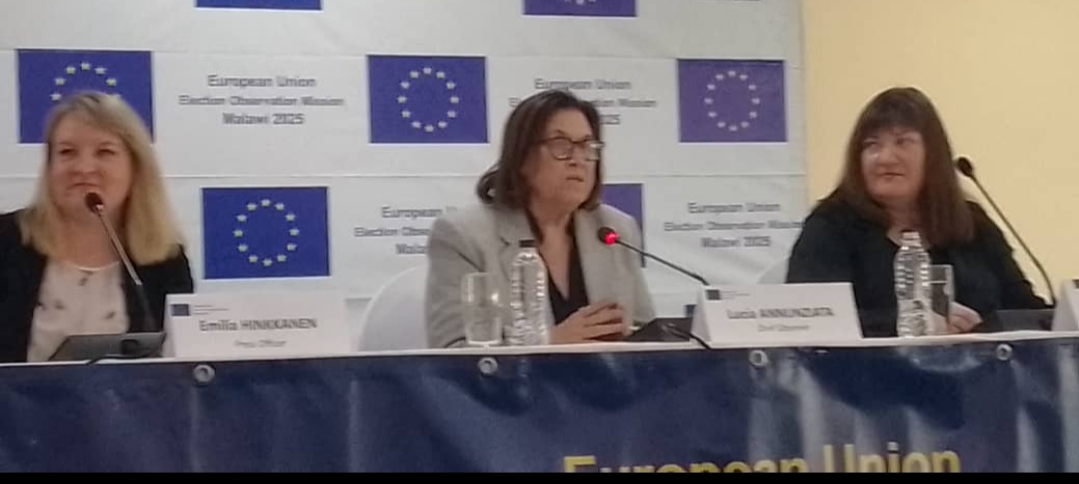
Releasing the mission’s final report in Lilongwe, Chief Observer Lucia Annunziata, a Member of the European Parliament, said the polls demonstrated Malawi’s strong commitment to democratic principles and popular sovereignty. Despite the overall positive assessment, she noted that the campaign environment “was not equally favourable for all candidates,” pointing to weak campaign finance regulation, bias in state media, and the under-representation of women.
The report outlines 21 recommendations aimed at strengthening future electoral processes, including reforms in election administration, technology, campaign fairness, media independence and dispute resolution.
“Our recommendations are exactly that — recommendations,” Annunziata stressed. “It will be up to Malawian authorities and electoral stakeholders, including civil society, to decide how to address and implement them. This is a matter of national sovereignty.”
According to the mission, the 2025 elections were conducted within a solid legal framework and overseen by a professional administration.
However, unclear communication on the use of election technology, delays in resolving disputes and insufficient rules governing campaign funding affected public trust.
A diverse media landscape was overshadowed by state-broadcaster bias, and many women were unable to compete meaningfully due to financial constraints.
Among its six priority recommendations, the EU EOM urges Malawi to:
- Clarify procedures for the use and management of election technology, and consider creating a dedicated legal framework for electronic tools used throughout the electoral cycle.
- Improve fairness in campaign financing by setting limits on fundraising and spending, and requiring timely, detailed disclosure of political income and expenditures.
The mission’s full report offers additional guidance intended to support Malawian institutions as they consider future reforms ahead of upcoming electoral cycles.