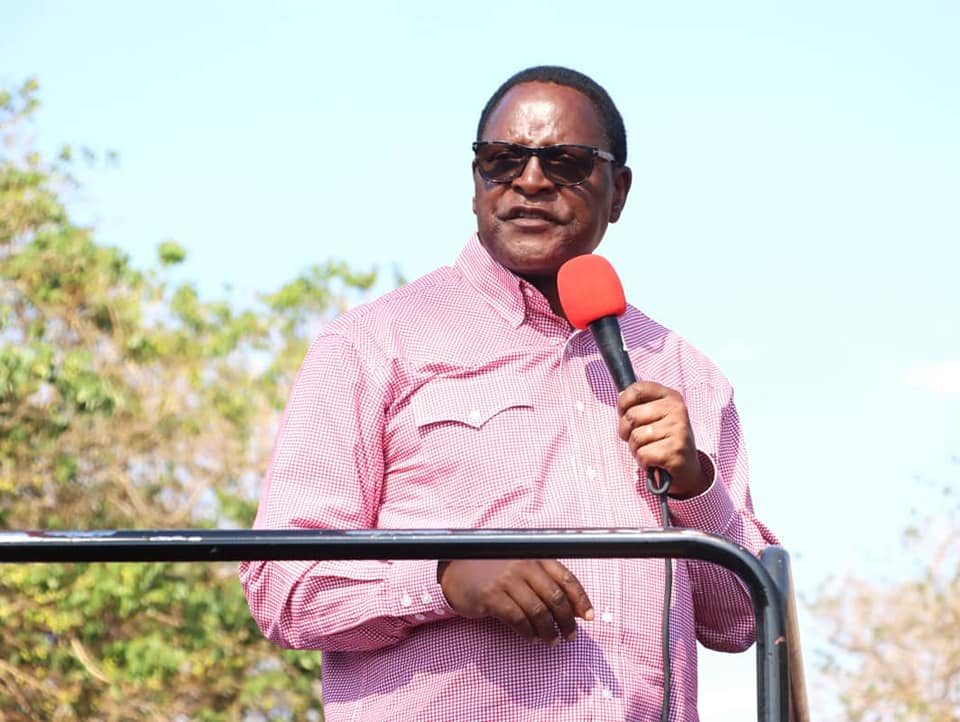

President Dr. Lazarus Chakwera has called on the National Economic Empowerment Fund (NEEF) to accelerate the disbursement of agricultural loans to ensure farmers have timely access to farm inputs. The President made the remarks on Monday during a visit to Chilowamatambe Trading Centre in Kasungu South East Constituency.
Highlighting Kasungu’s reputation as an agricultural hub, President Chakwera emphasized that the loans will provide much-needed capital for cultivating key crops such as maize.
“I am aware that the people of Kasungu have done so well in paying back the loans. These are the people that deserve to get more because they remember to pay back,” Chakwera stated. “The rains are here. Let’s expedite the disbursement of the loans.”
The President also underscored his administration’s dual approach to addressing food security. While promoting irrigation farming to mitigate food shortages, the government is distributing relief maize to families in need. In Kasungu alone, at least 43,208 families are set to benefit from the initiative, according to Khumbize Kandodo Chiponda, the Member of Parliament for Kasungu South East.
Speaker of Parliament Catherine Gotani Hara echoed the President’s sentiments, stressing the importance of supporting agricultural districts like Kasungu, which contribute significantly to the country’s foreign exchange earnings through farming. She also urged citizens to register and vote in large numbers, attributing recent agricultural advancements to the Chakwera administration.
Kasungu’s agricultural sector has faced significant challenges this year, with the El Niño weather phenomenon prompting President Chakwera to declare a State of Disaster in March across 23 of Malawi’s 28 districts, including Kasungu. Despite these setbacks, the district’s resilience in repaying loans has been commended, reinforcing its eligibility for further support.
The push for swift loan disbursement comes as Malawi enters its rainy season, a critical period for planting and cultivation. The President’s appeal aims to ensure that farmers are adequately equipped to maximize their productivity and contribute to national food security.