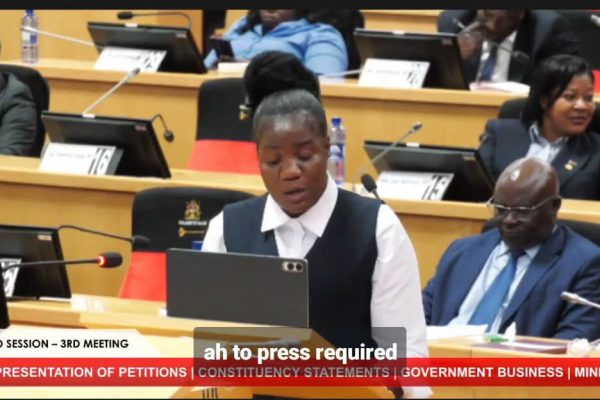
The Ministry of Natural Resources has assured Parliament of its full cooperation with the ad hoc committee investigating the proposed Mulalo Granular Fertiliser Production Factory in Mchemela, Dowa District, maintaining that environmental approval is a legal and technical process rather than a political decision.
Presenting a ministerial statement in Parliament, Minister of Natural Resources Patricia Wiskes said the ministry respects Parliament’s decision to establish the committee and is ready to provide all relevant documentation, correspondence, timelines and technical information required during the inquiry.
Although the initial parliamentary question was directed to the Ministry of Agriculture, Irrigation and Water Development, Wiskes said it was necessary to clarify the statutory role of the Malawi Environment Protection Authority (MEPA), which falls under her ministry.
“My remarks are not intended to pre-empt the committee’s findings but to help Parliament understand the legal framework governing environmental approvals,” she said.
Wiskes reaffirmed the government’s commitment to industrialisation and food security, noting that the proposed fertiliser plant has the potential to reduce Malawi’s reliance on imported fertiliser, create employment opportunities and promote local value addition.
She stressed, however, that all development projects must comply with the Environment Management Act.
“Environmental clearance is not a political decision. It is a legal and technical process undertaken by an independent statutory regulator to ensure development proceeds without compromising public health, environmental sustainability, and the rights and livelihoods of surrounding communities,” she said.
According to MEPA records, the project’s brief was submitted on 24 March 2025, with initial comments issued two days later. A preliminary Environmental and Social Impact Assessment (ESIA) report was received on 2 July 2025, but MEPA identified several shortcomings, including inadequate hazardous waste and wastewater management plans, weak occupational health and safety measures, poor site design, insufficient stakeholder consultations, and incomplete land ownership documentation.
The developer submitted a revised ESIA in March 2026, nine months later. MEPA completed its technical review in May 2026 within the prescribed 60-working-day timeframe.
During the assessment, the authority closely examined issues relating to acid residue management, contaminated sludge, phosphogypsum disposal, industrial wastewater treatment and potential impacts on the nearby Kang’ona River.
Wiskes said economic growth and environmental protection should go hand in hand.
“Environmental regulation should never be viewed as a barrier to investment. Rather, it is a safeguard that ensures development is lawful, environmentally responsible and beneficial to both present and future generations,” she said.
She further disclosed that a final revised ESIA was submitted on 17 June 2026. The MEPA Technical Committee met on 22 June 2026 and concluded that the key environmental concerns had been adequately addressed before recommending the project for consideration by the MEPA Board.